Skip to content
Agency Pilot

Win clients

Local SEO sales reports for prospect conversations

Prepare a branded prospect report from relevant public search evidence, explain opportunity estimates and discuss a realistic scope. Review the business context before sharing, then carry the accepted baseline and responsibilities into onboarding.

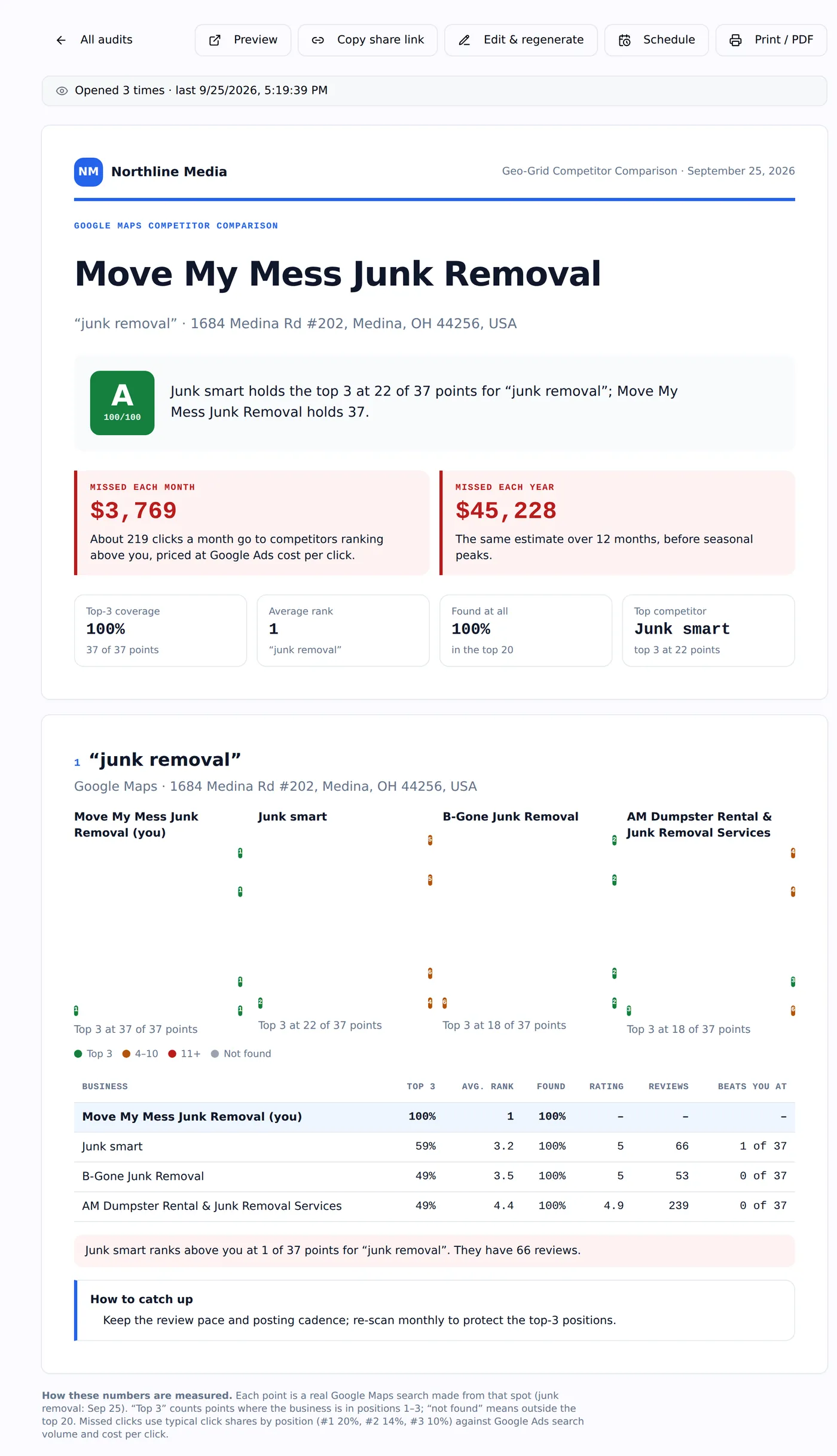
A branded report showing an A grade, $3,769 missed each month and $45,228 missed each year, with competitor rankings
Estimated search opportunity on your branding. Ad-equivalent traffic value is not booked revenue.

The Sales Report

Nine grades across twelve sections, fixes ranked by value and a 90-day plan.

The Prospect Scorecard

One page: map-pack position, review gap, site speed, traffic value and a modeled opportunity estimate.

Estimated traffic value

A model of potential search clicks, valued using Google Ads cost per click. It is an opportunity estimate, not a sales forecast.

Opened alerts

A notification on the first real open, and again if they come back a day or more later. Bots are ignored.

A whole territory at once

Run scorecards for up to 100 businesses from a CSV and sort by grade.

Your words, their numbers

An AI can polish the cover text, but it's rejected if it adds a number that isn't in the data.

What's in the Sales Report

The Sales Report runs a geo grid for the prospect's main keyword and pulls together their map rankings, Business Profile, reviews, website health, organic traffic value, share of voice and AI visibility. Each area gets a grade, and the report ends with the fixes ranked by what they're worth and a 90-day plan — the proposal is half-written before the call.

It costs 300 credits, and reuses any recent scan of the same business so you don't pay for it twice.

Know when to follow up

Every report is a share link on your branding. The first time a real person opens it, you and your admins get a notification; if they come back a day or more later, you hear about that too. Visitor IPs are stored hashed, and bots and link previews don't count.

That's the difference between a cold follow-up and "I saw you had a look at the report this morning — any questions?"

Onboard them the same day

When they say yes, send an onboarding link. Their Business Profile, Google Ads, Analytics and Search Console connect in one pass, the prospect becomes a client, and the scan you pitched with becomes month one of their ranking history.

The numbers

Sales tools and what they cost

Sales Report300 credits
Progress Report150 credits
Prospect Scorecard and other auditsPriced in credits, shown before they run
Bulk runsUp to 100 businesses per CSV, with CSV export

What this does not do

Better to find this out here than three weeks in.

  • Reports are hosted on an Agency Pilot share link with your branding, not on your own domain.
  • The report's missed-revenue label refers to an estimate based on search volume, position-based click-through assumptions and Google Ads cost per click. This is ad-equivalent traffic value, not lost sales, profit or guaranteed future revenue. Discuss conversion and sale-value assumptions separately.

Questions

What should a local SEO sales report include?
Where the prospect ranks across their area, how their profile and reviews compare with the map-pack leaders, their website's health, what their search traffic is worth, and a clear plan with the value of each fix.
Do I need the prospect's permission to run it?
The report uses public search and web data, the same things anyone can see by searching.
Can I edit the report before sending?
Yes. Edit and regenerate the cover text, then share, print or save it as a PDF.

Put your agency on autopilot

Start a 14-day trial with 300 credits. Add your first client and send an onboarding link today.

Prepare a prospect conversation from relevant evidence

The sales-report workflow starts with a prospect’s business question and ends with a scope they can assess. Confirm the business, target service and area before preparing the report. Then choose a small number of findings to discuss, explain the supporting observations and identify what the owner still needs to verify. The audit catalogue helps select individual investigations; this page focuses on presenting their relevance in a sales conversation.

Keep opportunity estimates separate from recorded business outcomes. A prospect report can help explain why an issue deserves attention, but it does not establish the revenue a business will gain by hiring the agency. Use the conversation to confirm priorities, dependencies and approval contacts. If the owner chooses to proceed, carry the accepted scope and baseline into onboarding. An opened notification is context for follow-up, not evidence that the proposal has been accepted or that every section was read.

Lead with an observation the owner can verify

A concrete opening is easier to discuss than a broad claim that the business is missing out. Show the prospect which query, location or public profile the report assessed. Explain one relevant observation, such as uneven map visibility, unclear service information or a review-response gap. Let the owner confirm whether the underlying service and territory match the work they want to win.

Use plain language for the implication and avoid turning a measured gap into an unsupported diagnosis. A low result in one sampled area does not mean no customers there can find the company. A weak public signal does not prove the agency knows the cause. Present the evidence, ask about its relevance and use the response to refine the plan. That makes the sales conversation more credible and the proposed work easier to justify.

Explain traffic value before discussing opportunity

Search reports can express the advertising-equivalent value of estimated traffic using search demand, position assumptions and cost-per-click data. That can be a useful way to discuss the scale of a visibility opportunity. It is not the same as verified revenue, profit or the amount a business is certain to recover. A business's actual outcome depends on clicks, enquiries, conversion, capacity and the value of completed work.

Make the distinction explicit when walking through a report. If a figure uses advertising costs, explain that basis before discussing it in monetary terms. Ask the prospect for their own commercial context rather than inventing a conversion rate or average job value. If you create a scenario for the conversation, label every assumption and keep it separate from the report's observed data. A transparent estimate supports a decision without becoming a promise.

Translate findings into a staged scope of work

A useful proposal groups work into a sequence the client can understand. Begin with verified issues and the access or information needed to address them. Then describe the next stage of content, profile or measurement work, followed by a review of what changed. The report's suggested plan can help structure the conversation, but the agreed scope should reflect the prospect's priorities and the team's actual capacity.

For each phase, explain the deliverable, dependency and way completion will be checked. A profile correction depends on accurate owner-supplied facts and appropriate access. A new service page may require subject knowledge, photographs and approval. A visibility review needs a comparable baseline. These details turn a list of recommendations into a project the client can assess, while avoiding a guarantee that a particular ranking or financial result will arrive on a fixed date.

Review the cover text and sharing details before sending

A branded report represents your agency, so review more than the logo. Check the business name, location, website, observation context and any financial terminology in the cover text. Make sure the next step is clear and appropriate to the relationship. A prospect should know whether you are offering a short discussion, a deeper investigation or a defined proposal.

Agency Pilot can help prepare cover text, but the agency remains responsible for the claims it sends. Keep the narrative aligned with the report's evidence and remove any unsupported number or certainty. Share only the material relevant to the intended recipient. Reports use an Agency Pilot share link with your branding, so describe that accurately rather than promising a custom-domain experience. A careful final review protects the usefulness of the report and prevents avoidable questions about basic details.

Use report engagement as context for a helpful follow-up

An opened notification gives the agency a signal that the report was accessed under the product's tracking rules. It does not prove that the decision maker studied every section or intends to buy. A link may be forwarded internally, and a recipient may need time to gather information. Use the signal to prepare a relevant follow-up rather than assume agreement or urgency.

A useful next conversation asks whether the service area and priorities in the report match the prospect's goals. Offer to explain the observation most relevant to their business and clarify the distinction between measured evidence and estimates. Keep the tone helpful, and follow the communication permissions and process appropriate to the relationship. The objective is an informed decision about the work, not simply a response to the fact that a link was opened.

Carry the sales baseline into onboarding

When the prospect chooses to proceed, retain the report and the assumptions discussed during the sale. Confirm the exact services, locations, deliverables and measures included in the engagement. Arrange the needed account access through onboarding, then assign the first tasks with clear owners. This prevents a gap between what the report suggested and what the delivery team believes it is responsible for doing.

Keep the original scan or audit as a baseline where the settings remain comparable. Future reports should distinguish completed work, new observations and actual recorded outcomes. If discovery changes the plan, explain why and update the scope with the client. The strongest handoff preserves both the evidence and the limits discussed during sales, allowing the team to deliver a coherent service instead of inheriting an impressive report with unclear promises.

Frequently asked questions

What should I confirm before generating a prospect report?

Confirm the exact business, branch, website, main service and target market. Public data can support the analysis, but the prospect still needs to validate whether those choices reflect their priorities. A report about the wrong location or an unwanted service can be technically detailed yet commercially irrelevant. Keep the scope visible so the recipient can quickly understand what was assessed and why.

How is a scorecard different from a full sales report?

A scorecard offers a concise starting point for a conversation, while a fuller report brings together more areas of evidence and a proposed plan. Choose based on what the prospect needs to decide and the relationship's stage. A longer document is not automatically more persuasive. The agency should be able to explain the chosen findings and the specific next discussion they support.

Can I call estimated traffic value lost revenue?

Avoid presenting it as verified lost revenue. Advertising-equivalent traffic value is based on a model and search-related inputs, while revenue depends on actual sales and business performance. Explain the figure's basis and limitations before using it in a pitch. If discussing a commercial scenario, label the assumptions separately and invite the owner to provide the facts needed for a more relevant calculation.

Should I put a guaranteed return in the proposal?

A report does not establish a guaranteed financial return. It contains observations and estimates that can help prioritize work. Describe the deliverables, responsibilities and reporting process the agency can commit to, and keep outcome expectations appropriately qualified. The client can then assess the proposed service without confusing a modeled opportunity with money that is certain to arrive after the engagement begins.

How many findings should I discuss on the first call?

Choose a manageable number that directly relates to the prospect's priorities and that you can explain with evidence. There is no benefit in walking through every section if the owner cannot connect it with a business decision. Begin with the most relevant observation, confirm its context and use the conversation to decide whether deeper analysis or a formal scope is useful.

What if the prospect disagrees with the target keyword?

Treat that as valuable discovery. Ask which services and customer questions matter more, then review whether the report's query should change. Do not defend an irrelevant term merely because it produced a dramatic result. A revised baseline that matches the business is more useful than a persuasive presentation built around work the owner does not want or cannot deliver.

Does a report open mean the prospect is interested in buying?

It establishes recorded access to the shared report under the product's behavior, not purchase intent. The recipient may be browsing, comparing information or forwarding the link. Use the signal as context for a helpful conversation and avoid claiming you know what they thought about the report. A direct response or discussion is needed to understand whether the proposed work fits their needs.

Can I edit the report's introduction before sharing it?

The existing sales-report workflow allows the cover text to be edited and regenerated. Use that step to clarify the business problem, explain estimates and give an appropriate next action. Keep factual claims tied to the report's data. Editing the narrative should make the evidence easier to understand rather than add predicted outcomes or unsupported numbers that strengthen the pitch at the expense of accuracy.

How should I explain a proposed ninety-day plan?

Describe it as a sequence of work and review points, with dependencies and responsibilities made explicit. Confirm that the client can supply information and approvals when needed. A plan can organize delivery without guaranteeing that a ranking or revenue target will be reached within the period. Adapt the report's suggestions to the actual engagement rather than treating them as a fixed promise.

What should happen between an accepted proposal and the first task?

Confirm the scope, responsible contacts, required access and measures of progress. Retain the report and any assumptions discussed in the sale so the delivery team understands the context. Then assign the first approved actions through your normal client workflow. This handoff prevents the report's broad recommendations from being mistaken for a fully agreed list of work with no further decisions needed.

Can I use the report for a business with multiple branches?

Keep each branch's identity and local context clear. A result for one location does not establish the same opportunity at every branch. Decide whether the conversation concerns one location or a wider account, and use suitable observations for that scope. When summarizing several locations, preserve enough detail for the prospect to understand which finding and proposed action belongs to which branch.

How do I handle a result that looks surprisingly bad?

Validate the business identity, query, area and underlying evidence before highlighting it in a pitch. A dramatic grade is not a reason to skip verification. If the observation remains uncertain, explain that uncertainty or investigate further. A measured, reproducible issue is more useful for a client relationship than an alarming claim that cannot be supported when the owner asks a simple follow-up question.

Should the proposal include work the audit did not evaluate?

It can include additional services when they are separately justified and clearly scoped, but do not imply that the audit proved a need it did not examine. Explain the source of each recommendation, whether that is the report, a discovery conversation or further investigation. This gives the client a transparent basis for evaluating the whole proposal and prevents unrelated work from borrowing the report's authority.

How can I compare the sales report with later progress?

Retain the original evidence and repeat comparable measurements where appropriate. Record changes in scope, location or keywords so the comparison remains honest. Later reporting should distinguish work completed, observed visibility and actual recorded business outcomes. The baseline helps explain progress, but it does not turn every subsequent change into proof that the agency alone caused the result.

What makes a report useful even if the prospect does not buy?

It can provide a clear explanation of a relevant public observation and a sensible question for the owner to investigate. Keep the advice understandable and avoid framing every finding as an emergency. A useful report stands on the quality of its evidence and interpretation. That gives the prospect something practical to consider and reflects well on the agency's judgment regardless of the immediate sales outcome.