Skip to content
Agency Pilot

From prospect to client

A CRM for marketing agencies with a next step after the sale

Keep the prospect's context through the conversation, proposal and client handoff. Agency Pilot connects relationship management with delivery, while giving your clients a separate workflow for the enquiries your marketing generates.

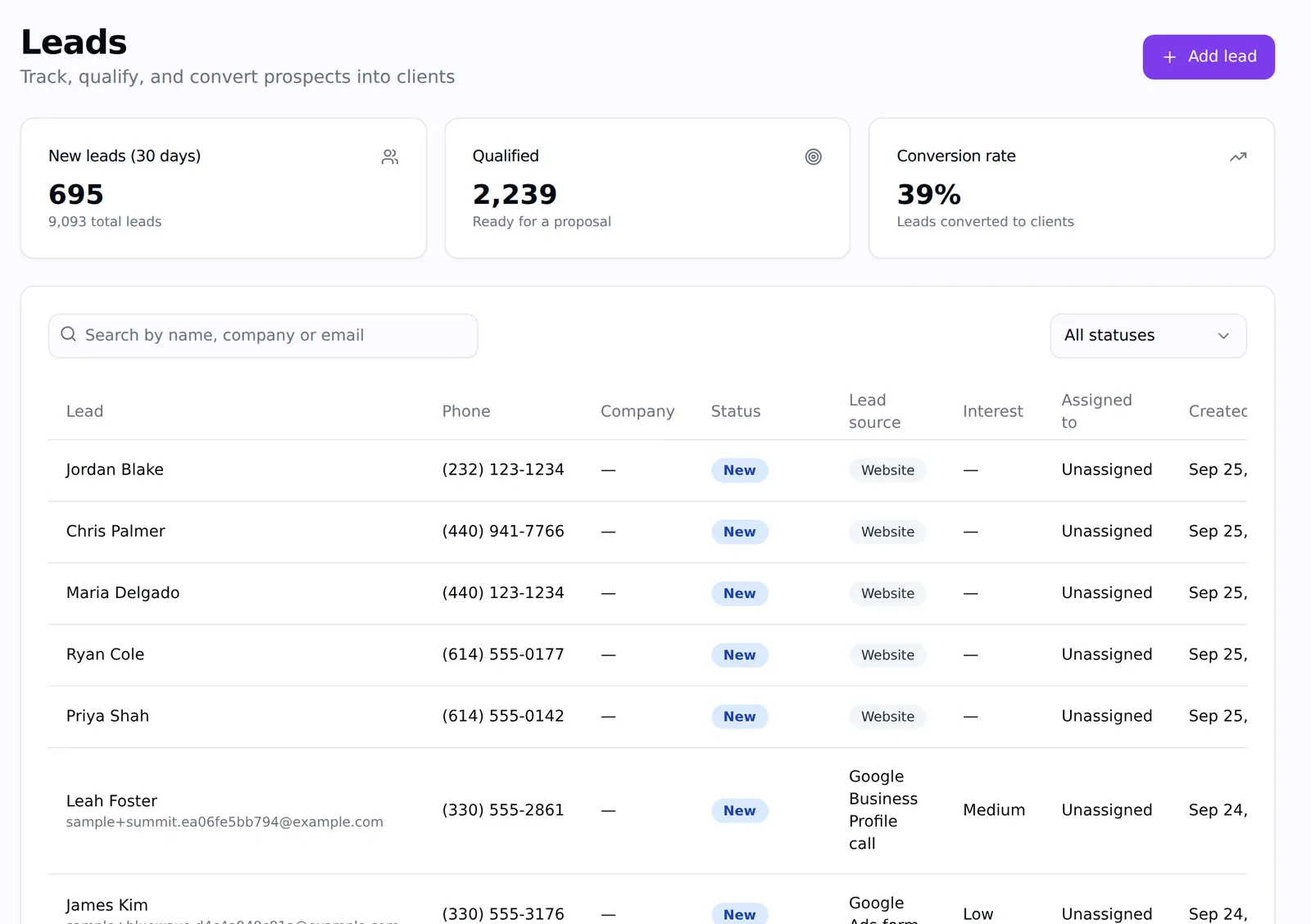
Agency Pilot lead list showing contact information, sources and pipeline statuses
Lead records with the source and status needed for follow-up.

Understand the enquiry

Captured leads can carry source, campaign and visit context, so the conversation starts with more than a name and an unexplained form submission.

Keep follow-up connected

Use the documented communication channels and record useful notes. Give the next colleague enough context to continue the conversation.

Present an actionable proposal

On supported plans, send a private proposal page with saved evidence, service options, signature and payment through your own Stripe account.

Move into the client relationship

Convert an agency prospect to a client and organize the next stage around access, delivery and reporting rather than rebuilding the relationship elsewhere.

Measure client acquisition outcomes

For the businesses you serve, source attribution and recorded sales connect their enquiries with marketing results. Keep this separate from your own agency sales discussion.

Give the handoff an owner

Use tasks, internal procedures and configured automations for the operational follow-through. A signed deal still needs a clear kickoff process.

Two pipelines, two business questions

An agency selling its own services wants to know which prospects need a response, what has been discussed and whether the engagement is ready to begin. A client receiving leads from that agency wants to know which enquiries are suitable and what became paid work. Both involve relationship records, but they should not be confused in a sales review.

Agency Pilot supports the relationship around the agency's client record and the lead workflow within each client's business. Define which process you are evaluating before choosing metrics or access. A client's booked job is evidence about their marketing outcome; it is not the same thing as a new retainer sold by your agency.

Keep the proposal grounded in the conversation

Before sending a proposal, record the prospect's need, the services being considered and the next decision. Saved scans and audits can provide useful evidence for a relevant engagement, but they should support a clear scope rather than overwhelm the prospect with findings.

Interactive proposals let the recipient review options and complete the documented acceptance flow. Plan selection, signature and payment are different events. Decide which event should begin your delivery workflow and verify the resulting client and billing records before treating the handoff as complete.

Choose a CRM around the process you need

Start with a representative enquiry and follow it through qualification, proposal and kickoff. Check how the team records decisions, how another colleague picks up the relationship and what the client needs to do after accepting. That practical walkthrough exposes important requirements sooner than comparing feature counts alone.

The documented lead stages are fixed: New, Contacted, Qualified, Converted and Lost. The product is not a bulk email marketing system, and the published lead workflow does not provide a spreadsheet bulk import. If your sales operation depends on custom stages, specialized forecasting or a particular migration route, evaluate those requirements explicitly before assuming a fit.

What this does not do

Better to find this out here than three weeks in.

  • The documented lead pipeline uses fixed stages rather than custom stage definitions.
  • Client-generated leads and agency sales should be interpreted in their own business context; source and revenue metrics depend on the underlying records.
  • Interactive proposals are not included on every plan. Connected communication and payment providers have their own setup requirements.

Walk through your next client relationship

Compare the plans against your sales process, then test the handoff with a representative enquiry.

Choose a CRM around the agency's sales conversation

A CRM for marketing agencies should help the team understand the opportunity and decide what to do next. Begin with the questions a salesperson needs answered: why the prospect contacted you, which service they need, what has already been discussed and who is waiting for a response. Then follow the relationship through proposal and kickoff. An attractive contact list is not enough if the delivery team later has to reconstruct the agreement. Evaluate the actual workflow with a realistic enquiry, including the information a colleague would need if the original salesperson were unavailable. This makes relationship continuity a concrete selection criterion.

Keep prospect qualification specific to the service

Qualification should reflect the work your agency can deliver. Confirm the business problem, the relevant services, the expected timing, the decision process and any access dependencies. Avoid assuming that an interested form submission is ready for a proposal simply because it includes a budget. A prospect may need a different service, lack control of an important account or be asking for an outcome you cannot responsibly promise. Record these points in plain language. A good qualification note helps the next person judge fit and prepare a useful conversation rather than repeat the same discovery questions or rely on an unexplained label such as hot lead.

Give every follow-up a purpose

A useful next step resolves a decision or gathers missing information. Instead of recording only that a prospect should be contacted again, identify what the follow-up needs to accomplish: confirm the service scope, review an audit finding, identify the signer or discuss an objection. Record the timing that was actually agreed and who owns the response. Connected communication can support the exchange, while notes preserve context for the team. Do not mistake an automated reminder for a completed sales conversation. The relationship advances when the prospect and agency become clearer about fit, commitment and the next decision, not merely when another message is sent.

Make discovery evidence relevant to the proposal

Marketing agencies can collect extensive data about a prospect, but not every finding belongs in a sales document. Select the scan, audit or account evidence that explains the work being proposed. State the assessment date and distinguish observed problems from possible causes. For an illustrative local-search engagement, weak visibility in a service area may justify investigation and a defined improvement plan; it does not establish a guaranteed number of future jobs. Use the prospect's own knowledge to assess assumptions about lead handling and service value. This approach makes the proposal a reasoned offer rather than a collection of alarming metrics followed by a price.

Explain the commercial decision before acceptance

The prospect should understand the service, recurring amount, setup fee, optional additions and term before reaching the signature or payment step. Interactive proposals can present options and support the documented acceptance journey, but clarity still depends on the offer you write. If a calculator is included, explain its assumptions and present the result as an estimate. Review the amount due now separately from later invoice scheduling. A salesperson should be able to describe the same agreement that the prospect sees on the page. This consistency protects the delivery handoff from expectations created informally in a call but absent from the accepted scope.

Design the sales-to-delivery handoff deliberately

Define what delivery needs to begin: the accepted scope, client identity, access requirements, commercial status and the first owner. Some records can be created through proposal acceptance, but a kickoff project and onboarding link are not automatic consequences unless the relevant workflow is configured. Signature and payment are separate milestones, so choose the event that matches your operating agreement. Review the actual resulting records during rollout. The handoff is complete when the delivery team understands what it is expected to do and the client knows what comes next, not simply when sales marks the opportunity as won.

Separate client lead performance from agency new business

An agency can use lead records to help clients evaluate the enquiries their marketing generates. Those records support a different business question from selling your own retainers. A client's lead may become a repair job, appointment or installation, while an agency prospect becomes a service engagement. Keep the ownership, terminology and reporting audience clear. When clients update their lead statuses and record sales, they improve the evidence available for their marketing review. That evidence can support your agency's client relationship, but it should not be counted as though each customer acquired by a client were a new account sold by the agency itself.

Evaluate constraints before committing to a migration

List the sales requirements that are essential to your agency, including stage definitions, historical data, communication channels and the handoff into delivery. Compare them with documented capabilities rather than assuming that every CRM category feature is present. Agency Pilot's published lead stages are fixed, and the described workflow does not include a spreadsheet bulk import or bulk marketing email system. Decide how existing opportunities will be handled while new work enters the chosen process. If a requirement needs a different tool, define the boundary and test the handoff. A clear fit assessment is more useful than discovering a critical limitation after the team has changed its routine.

Frequently asked questions

What should a marketing agency look for in a CRM?

Look for a reliable way to understand the relationship, record the next decision and hand a won engagement to delivery. Test a real prospect journey rather than comparing feature labels alone. The right fit depends on your services, stage requirements, communication habits and the information the delivery team needs after the commercial agreement is accepted.

Is this page about selling agency services or managing client leads?

The primary buying question here is the agency's own relationship and sales workflow. Agency Pilot also supports leads generated for client businesses. Keep those uses distinct: an agency prospect may become a retainer client, while a client's enquiry may become one of that business's jobs. Each deserves its own interpretation and responsibility.

Can an agency prospect become a client record?

The documented lead workflow supports converting an agency prospect into a client. Before making that transition, confirm the relevant agreement and ownership of the next step. Conversion provides a useful bridge, but the agency should still verify scope, access and kickoff responsibilities rather than assuming a client record alone means delivery is ready.

Can I define my own pipeline stages?

The documented stages are New, Contacted, Qualified, Converted and Lost. Map your process to those definitions and use notes for relevant detail, or evaluate another approach if custom stages are essential. Do not choose the product on the assumption that every agency can configure a completely different stage model through this workflow.

What should we record during discovery?

Capture the business need, service fit, timing, decision process and important dependencies. Include what remains uncertain and the next question to resolve. A colleague should be able to understand why the prospect is considering your agency without repeating the entire first conversation. Keep the note factual and useful rather than filling it with a generic enthusiasm score.

How do we make follow-up less dependent on one salesperson?

Record the context and purpose of the next action, along with the responsible person. Preserve important decisions in the working record rather than a private memory or an unexplained calendar reminder. Connected conversations help, but another colleague still benefits from a concise summary of what was promised and what the prospect needs next.

Can interactive proposals support an agency sales process?

On plans that include the feature, they provide a private page with selected evidence, service options and the documented signature and payment flow. Use them after clarifying the prospect's need and scope. Review plan availability and configuration first, and keep the proposal's claims consistent with the actual service your agency is prepared to deliver.

Does clicking a proposal plan mean the prospect has agreed?

No. It is an engagement signal that may inform a helpful follow-up, not proof of acceptance. The prospect may be comparing options or discussing the offer internally. Use the event as context and distinguish it from signature and payment milestones when deciding which operational actions should run.

Should a revenue calculator be used to promise a result?

No. Its output depends on assumptions and should be presented as an estimate. Review the inputs with the prospect and explain uncertainty about demand, qualification, booking and job value. A useful calculator supports a commercial discussion; it should not create a guarantee that the sales or delivery team cannot substantiate.

What must happen after a prospect signs?

Check whether any payment step remains, verify the resulting client and commercial records, and start the agreed onboarding workflow. Assign a delivery owner and explain the next request to the client. A signature is an important milestone, but it does not by itself confirm that all access, payment or kickoff requirements have been completed.

Can I import an old spreadsheet of leads in bulk?

The published lead workflow does not provide a spreadsheet bulk import. Plan historical handling explicitly before moving an existing sales process. Decide where older opportunities will be completed and how new enquiries enter the chosen workflow. Avoid promising a migration route to the team until you have verified that the required method actually exists.

Is the email connection a campaign mailing platform?

No. The documented email workflow connects existing mailboxes for communication and does not represent a bulk marketing email system. Separate direct sales and client correspondence from newsletter or large-scale campaign requirements when assessing fit. Connected provider configuration also remains part of the setup and support responsibility.

How does the client lead workflow support retention discussions?

Clients can update outcomes and record sales, which helps connect their marketing enquiries with business results. Use that evidence alongside the work delivered and the client's goals. It can make a review more concrete, but incomplete sales updates or a short reporting period should not be presented as a complete judgment about the engagement's value.

Can the CRM tell us exactly why every deal was lost?

Only to the extent that the team records reliable information. Ask what the prospect actually decided and distinguish confirmed reasons from the salesperson's inference. Useful loss notes can improve positioning or qualification over time, while unsupported labels can lead the agency to change the wrong part of its offer.

How should a small agency test whether this is a fit?

Walk a representative enquiry through qualification, follow-up, proposal and client kickoff. Have a second person pick up the record to test whether the context is sufficient. Check the documented limits, required providers and plan features during that exercise. The goal is a workable sales-to-delivery process rather than a perfect-looking demonstration with none of your real constraints.